The Future is Bright

A Full Critical Analysis of Bojack Horseman – 5/4

Related image

For my final entry of my semester-long blog about Bojack Horseman, I will be discussing my overall evaluation of the show itself, the creators, the show’s public reception, and finally why I chose this specific show to analyze.

My thesis statement is that this show is truly one-of-a-kind for a number of reasons, but the biggest being that it gives the most accurate representation of the issues that it poses. For example, the issues of depression, isolation, abuse, and most importantly, self-discovery. I chose to analyze this aspect of the show not only because I believe it is what the show ultimately means to accomplish, but also because these types of representation have never been shown in this magnitude through this type of medium. I will be discussing material from multiple episodes for the reader to understand where I am coming from. The episodes I will be referencing the most are “The Old Sugarman Place”, “Stupid Piece of Sh*t”, and “Ruthie”.

Bojack Horseman is a show about a TV star. Sorry, not just any TV star, but a washed-up TV star. I apologize again, not just any washed-up TV star, but a washed-up TV star who is also an animated anthropomorphized horse with major self-destructive tendencies. Now I’ve got your attention. The show is set in present day Hollywood, only the residents are a mass mixture of humans and humanized animals who inexplicably all speak the same language (except for the fish, you need a special underwater helmet to converse with them). The show follows the life of Bojack Horseman, who was big in the world of 90’s sitcoms and not much else. Now his days consist of drinking, watching reruns of the sitcom he starred in 25 years ago, bossing around his rent-free tenant, Todd, and finally more drinking. However, with the help of a ghost-writer who eventually becomes one of Bojack’s closest friends, a tell-all memoir about the life and work of Bojack Horseman becomes a bestseller and puts him back to work. There is one problem though, this memoir tells the story of his extremely brutal and abusive upbringing, as well as sheds light on his current problems (something Bojack missed by not reading any of it until it was published), and this brings Bojack right back to where he started: a lost soul consisting of anger, self-loathing, and vodka.

Now this may not be the feel-good show of the decade, but it’s not supposed to be. The show’s creator and showrunner, Raphael Bob-Waksberg, created the Bojack character to emulate most of what he himself went through as someone trying to “make it” in the fast-paced and often cruel world of Hollywood. He describes in a number of interviews that the struggle and isolation he felt when he was first living in L.A. is what inspired the complex and broken character of Bojack. Even the actor who voices Bojack, Will Arnett, has stated that this role might be the hardest he had ever taken, as the dark places he had to travel to when getting into character was hard not to take home with him. This intensity is not lost on it’s viewing audience either. As I discussed in one of my previous blog posts, even though the show is not as much a household name as say “Friends” or “Lost”, its notoriety for being one of the most innovative and original show on television is more than prevalent. In other words, not everyone watches it, but those who do, both average Joe and critic alike, recognize its ingenuity.

When I first started watching this show and eventually analyzing it for this course, I was skeptical of its potential as a quality TV program as its premise is so strange. However, after giving it a chance and taking a hard look at what the show is actually saying to its viewers, I finally understood why critics like those at Rotten Tomatoes, The AV Club, and IMDb, praise it for how raw and truthful it is. The question I ask with most shows that try to tackle the real issues of life is “how is this show successful in representing real-life struggles?”. This brings me back to the examples in the episodes I stated above.

Image result for bojack the old sugarman place

The episode that I think best represents the dark, sinking feeling of isolation is “The Old Sugarman Place”. This episode takes place in Michigan, in the summer home of Bojack’s mother’s family. Bojack has for all intents and purposes been broken by the harsh world he was living in back in Hollywood and spends the winter tucked in a corner of the house, with nothing but a blanket, liquor and his phone. This episode shows the turmoil of someone who truly feels like they have nowhere to go. He doesn’t take calls and doesn’t speak to anyone until his neighbor realizes that someone has been squatting in the house and offers to help him fix it up. For the better part of a year, Bojack and this complete stranger who happens to be a handy man (and also living alone) fully restore the house. There is a very powerful moment in this episode. After the two of them complete the restoration, Bojack intentionally throws himself off of a ladder to try and get the stranger to save him (the stranger is a housefly that “doesn’t fly”, something he tells Bojack when they first meet). The stranger does attempt to catch Bojack by flying but Bojack has already fallen. Bojack points out to the fly that he is, in fact, flying. This realization sends the fly into an anger-filled panic, who then lifts Bojack high into the sky as reparation, and asks Bojack if he wants to know what Lorraine (the fly’s late wife) felt when she flew a little too high and was sucked in and killed by the engine of an airplane. The fly and Bojack fall into the lake after this fiasco, and Bojack realizes that the fly is not swimming and saves his life, only to be met with the fly pleading to Bojack that he doesn’t want to live anymore. This moment gives Bojack hard insight into the isolated life that this stranger was living and how personal loss and pain negatively affected him to the verge of attempted suicide. This episode also emphasizes the issue of self-discovery that Bojack undergoes, realizing that he is not the only one out there struggling with these types of issues.

The episode “Ruthie” is an extremely creative one that shows the breaking point of even the strongest of characters. It is set many years in the future, where a teenage cat, Ruthie, is giving her class a presentation on one of her relatives, Princess Carolyn, one of the present-day characters in Bojacks life. She describes to her class that Princess Carolyn was a strong and independent cat who took shit from no one and chose her own destiny, but that one unfortunate day changed her life forever. This message then throws us back to the present day, with Ruthie narrating. Princess Carolyn had been enjoying the longest relationship she’d ever had, ironically with a mouse with whom she discussed having children. Her day goes from bad, with her favorite necklace breaking, to worse, with her finding out that she would never be able to have children, and eventually breaking up with the only person she ever loved. The episode is extremely painful to watch, especially when we see at the end of all of the turmoil that filled her day, she is talking to Bojack about her struggles and how when she feels sad she likes to picture her great-great-great-granddaughter giving a presentation to her class about what an amazing person she was. Of course, we know now that the futuristic setting where Ruthie is, in fact, giving a presentation about her, is all an illusion, and the episode ends with Bojacks response to her telling him this.

Related image

Finally, the episode “Stupid Piece of Sh*t”. This is by far one of the darkest episodes in the series and absolutely nails the feeling one gets . This episode takes place in two locations: present-day Hollywood, and inside of Bojacks mind. We hear his inner-monologue talking about how awful he is as a person, followed by an almost bipolar response of how his actions are justified, followed once more by justification that his justification is bullshit. It is a back and forth battle all happening inside of his mind that really brings to light the struggle of a someone who hates themselves and wants nothing more than to be better, but doesn’t know how, so they must justify their actions any way they can, in order to feel the slightest bit of normality. Analyzing this episode is difficult, not in the sense that it is overly complicated to understand, but in the sense that it’s hard to watch depression so accurately represented and not at the very least feel for the character and the pain they’re going through.

Image result for bojack stupid piece of shit

To conclude this blog, I want to talk about my overall evaluation of the show and how the show has helped me realize things in my own life. Bojack Horseman is not for the faint of heart. It is also not for the happy-go-lucky TV watcher. This show breaks all conventional boundaries of what television has been up to this point. The jokes are dark yet employ fiendishly clever intertexuality, constantly referencing and poking fun at other television shows and real events that happen in our world (to give one example, there is an episode entitled “Thoughts and Prayers”). The narrative is original and complex and always leaves the audience waiting for a resolution that will never come. The show itself is meant to send messages of real depth and truth to its audience, making them take a step back and evaluate their life and the choices they make. Unlike most television shows, no one wants to be like the protagonist, and yet everyone sees at least a little bit of themselves in him. He is far from perfect, the antihero if you will, and always needs to change something about himself in order to fix a problem in his life. That, to me, is its own message: that no one can truly label themselves as all-knowing or perfect, no matter how much we try to convince ourselves that we are. The only way we can see real change in our lives is by changing, an extremely simple yet vastly complex problem that I think everyone has to face eventually. However, when we do eventually have to face it, hopefully we will have learned important lessons from characters like Bojack, and when we look ahead to where we are going in life, we can say to ourselves with complete certainty, the future is bright…

Image result for cuddlywhiskers bojack
Image result for Only after you give up everything, can you begin to find a way to be happy.

Bojack Horseman Judgement Post – 4/28

Related image

For this week’s blog post, I will be discussing what makes a specific television show successful. Right off the bat, for me, a successful show is a show that at least tries, whether they succeed or not, to connect to an audience in as creative a way as possible. Now, I know this may sound like a vague answer to a very complex question, but hear me out. Friends was by all accounts, one of the most successful shows on television for its time when it came to ratings and awards, but in my opinion it fell a little flat when it came to creativity or connecting to an audience. It was entertaining for millions of people, but it was, and still is, a “background noise” television show. The Big Bang Theory is probably not that far behind at least when it comes to sitcoms. For me, this is simply Friends but they’re all nerds, and again, fell extremely flat when it came to connecting to people. Now, the fact that these are only two show, both sitcoms, is not lost on me. However, they were considered some of the most successful shows on television. Friends was nominated for 62 Primetime Emmys and won 6. The Big Bang Theory was nominated for 46 Primetime Emmys and won 10. Sure, these shows have the hardware and the ratings to back-up the notion that they are “successful”, but I don’t find much creativity at all in either, and I think that is what makes a show successful.

Image result for friends big bang theory for stupid people meme

As much as I like talking about how base and dull shows like Friends and Big Bang Theory are, with a show like Bojack Horseman, creativity and innovation in terms of storytelling is what drives the through-line of the show. An animated, anthropomorphic horse who is also a washed-up TV star is extremely creative. Of course, this is all opinion, but this is what this blog post is about. I think a show is successful when it tries to break the mold of previous television premises. On top of that, Bojack Horseman talks about real life, in a real way. It talks about struggles that could apply to anyone: the struggles of finding a job, the struggles of feeling like you belong, the struggles of finding your place in the world. This is where an audience truly connects, and the critics seem to agree. Courtney Enlow from Bustle wrote an article entitled “How ‘BoJack Horseman’ Depicts Depression More Honestly Than Any Show On TV”. She describes that whenever we see a TV show try and accurately depict depression on screen we end up with “reductive dilutions and offensive stereotypes” from shows like Saved by the Bell and the aforementioned Big Bang Theory, and that even in the rare moments when these shows get it right, they lose touch with the reality of mental health by the end of the episode. Les Chappell from the AV Club wrote about the episode in which Bojack is giving a eulogy at his mothers funeral. He writes that Bojack Horseman once again set the bar for concept TV episodes, as this episode takes place in just the funeral hall, and Bojack is the only one speaking for over 20 minutes. This idea had never been thought of before, and probably was never even considered, especially because again, it consists of one character talking to a casket for 20 minutes about the awful life his mother gave him and how she contributed to the broken individual he is today. To a typical producer, this would seem like an outlandish and stupid idea, but for the audience, it humanized the character of Bojack and showed us what it might be like having to give a heartfelt speech about someone close to you that you despised. This episode is one of the highest rated episodes in the entire series for this reason. The show’s creators were creative and bold enough to write an episode of this depth, and the writers were nothing short of ingenious to use this episode to tell a truly heartbreaking story.

Television is a visual, storytelling medium. In my mind, it is one of the most versatile tools we have in the modern era to tell stories of actual value and depth, and so often this tool is wasted on the over-exaggerated, laughtrack-ridden sitcoms that tell us nothing other then variations of simple stories we’ve heard thousands of times. In my mind and in my heart, shows like Bojack will bring forth a new era of truthful storytelling in television and help rid the world of the useless fluff that plagues the current primetime television slots.

Related image

A Sitdram for the Ages

Analysis Blog – 4/7

For this week’s blog, I will attempt to dive deeper than ever before into the enigmatic television series that is Bojack Horseman with an in-depth analysis about the show and where it stands in the realm of television today.

Bojack Horseman, to put it plainly, is truly a one-of-a-kind show. It’s structure and narrative is complex and gripping to the point that one might find themselves getting choked up over the everyday life of an animated horse-man. This show is meant to be a present-day look into the life of a troubled television star. As I have said before, it takes place in various locations around Hollywood and L.A. and follows the lives of those in show business. While this particular premise is not meant to be the connecting factor to the public, the inner emotions and struggles of the characters are what really resonate with people from all around the world. Personally, I do not think this show could have survived in any other time period of television, or on anything other than a streaming platform such as Netflix. I believe this to be the case specifically because of the content and story structure. This show was made (and is still being made) in the period of online television where I feel the focus is more on the artistic expression and less on the ratings or how the public might perceive it (even though the ratings and overall reception of the show are, in fact, exceptional).

Bojack isn’t like other television series. Sure, it follows a narrative structure, has a main character and many supporting characters, and has all the trappings of what many would see as a simple tragic comedy. The reason why it sets itself apart from the rest is its consistent ability to convey the message it is trying to put out there in the most accurate way possible. The show was made by someone who not only feels for the tragedy in Bojacks life, but created the character to reflect how he feels about himself. The show doesn’t shy away from showing the real effects of things like depression, isolation, and social anxiety. It shows the viewer the harsh reality of what someone who is truly suffering is feeling, and how those feelings bleed into everyday life. In one of my previous blog posts, I talked about the episode “Stupid Piece of Sh*t” in which Bojack is struggling with taking care of himself, his aged mother, and a young girl he believes to be his illegitimate daughter. The episode takes us into the mind of Bojack who is constantly telling himself how stupid and awful and disgusting he is, and shows us how that affects him and those close to him. He takes out his anger on those he wants more than anything to love. He is unable to form close relationships with the people he wants that from the most. He convinces himself that he doesn’t deserve any happiness because of the things that he does to people, but does not know how to not do those things that drove them away in the first place. I, myself, battle with depression and social anxiety and have felt these exact feelings. To see this represented on screen in such a deep way that I have never seen before, was startling. I know I cannot speak for everyone battling depression and some form of anxiety, but this episode in particular hit the nail on the head when it comes to how one feels when truly depressed.

Another thing that sets this show apart is the use of the extremely faulty protagonist. Bojack is the definition of the antihero. He lacks outward empathy towards his closest friends and even family members. He manipulates people, he uses every resource given to him only to help himself, and has no moral compass when it comes to how he views true connection in relationships. All that being said, the viewer still on occasion finds themselves rooting for the character. Not rooting for them in the sense that they want him to continue to do the things he does, but in the sense that even though this emotionally damaged creature is an asshole to almost everyone in his life, we want him to get better. We want to see him take the necessary steps in order to right his ship and restore order in his life. We don’t want to see him fail, even though he does, and gives us every reason to be satisfied with that.

Image result for you have to be better bojack

To me, this show represents that there is fault in everyone, and that although it might hurt like hell, it’s okay to not feel like you have your life together. Most people don’t, and yet still find ways to be happy. This show tells us that no one is perfect, far from it actually. However, it does so in a way that leaves us wanting to be better, and I think in this way, it allows even the most average of Joe’s to connect to this lost soul on screen. Bojack Horseman truly shows the flawed nature of humanity. Our wants and desires, our pain and suffering, but most importantly, our ability to change. It tells us over and over again that we have to ability to change, but that we have to be the person that wants it the most. This show is meant to be a warning sign in our lives, the lighthouse that tells us we are okay, but that if we don’t slow down or change course, we might run aground. People who watch the show connect with this. They understand the representation being presented on screen about the hardships of life and how sometimes we need to power through, but sometimes we need help, even if we don’t know how to ask for it.

Representation of Reality 3/24

Image result for bojack fan art

For this blog post I will be discussing the representation of reality in Season 4 of Bojack Horseman. For starters, since the show is animated, reality must be interpreted. We do not see actors speaking their lines and walking through sets or locations. Although, the setting of the show itself, save for the anthropomorphic animals, is meant to represent Hollywood and the realities of the lives that reside in and around L.A.

When discussing class in Bojack Horseman, especially in Season 4, we get a dark glimpse into the environment and class system that Bojack grew up in. He grew up having the resources of higher class, but was treated by his parents as a mistake and the worst thing that could have happened to them, almost as if his mere existence made them as a family lesser in the eyes of the high class that his mother was used to. Beatrice Horseman, Bojack’s mother, was born Beatrice Sugarman, an heir to a very wealthy and powerful sugar conglomerate. Her mother and father were always surrounded by the common luxuries you would assume from a family of this influence. Bojack’s father, Butterscotch Horseman, who as of Season 4, we as the viewer know little about. Other than the fact that he was an aspiring novelist, we know he came from a broken, working class family. The two met at one of Beatrice’s débutante balls. Butterscotch was crashing it for free drinks and Beatrice was young woman who the ball was being thrown for. The two connected over their differences and wealth of knowledge, as well as famous authors and works of literature, causing them to basically elope and move to California after Beatrice gets pregnant with Bojack. This relationship soon deteriorated after Bojack was born as Butterscotch was hell-bent on “making it” as a novelist and Beatrice was adjusting to life a little lower on the totem pole. This, no doubt, formed the insecurities that Bojack himself would develop later in life starting off as a struggling comedian, to a sitcom star, to eventually a washed up icon from the 90’s.

Other than Bojack, we are surrounded by the high class of L.A. in what is supposed to be modern day Hollywood. Movie stars, professional athletes, and famous producers and agents make up most of the characters represented in Season 4 and most of the show in its entirety. The lower-working class is nowhere, only represented by humans and animals walking the streets.

When discussing race, it becomes almost nebulous, as the show features humans but also a myriad of human/animal hybrids. When it comes to humans alone, however, many different races of people make up the characters involved in the show. African American, Middle Eastern, Asian American, Hispanic and Caucasian characters are featured. There are almost no mentions of racial differences among characters, and nothing that makes the feeling of the show seem like it features predominantly one race or another. As for the human/animal hybrids, these characters are represented almost as if they are their own form of different races and ethnicity. It would almost be more appropriate to talk about the representation of different species rather than races, as humans are shows interacting with both other humans and human/animal hybrids alike. It is a very strange, but weirdly refreshing concept that this show brings to television, speaking to the notion that all the characters are simply living creatures.

When it comes to race representation, the same can be said about gender representation. Although the main character is male, the representation of genders and sexual identities are spread throughout the characters of the show. For example, Bojack’s best friends are Diane and Todd. Diane being a strong, self-possessed female writer, and Todd being one of the first characters I have seen on a television show that is openly asexual. There is very rich diversity when it comes to gender and sexual identity on this show, having gay, straight, bisexual and asexual characters, as well as male, female and transgender characters. Again, this diverse representation is refreshing to see in a television show in this day in age where we still have trouble with a lot of prime-time television shows having almost all Caucasian, mostly male-dominated casts. Even being an animated show set in the high class world of Hollywood, Bojack Horseman gives us a glimpse into what real life is: a melting pot of people of different races, genders, and identities (though some of those identities are horses, cats, and turtles). It sends a subtle message about how we are all different, yet all have similar wants and needs, struggles and triumphs and views of how good or bad the world around us are.

Bojack Horseman, although starting slow, quickly became one of the most popular streaming-only television programs on Netflix, as well as the internet as a whole. It’s creator, Raphael Bob-Waksberg, was inspired by the style of comic illustrator Lisa Hanawalt, and the story itself was inspired by Waksberg’s own “Going to Hollywood” story. Waksberg started out on the outskirts of Hollywood in a small, $400 a month room in a large house, which apparently looks a lot like the house that Bojack lives in. In an interview with The New Yorker, he describes looking out over the city feeling simultaneously on top of the world as well as never more alone and isolated, which he transcribes into the character of Bojack. This was Waksberg’s first television show which is remarkable in and of itself, but also of how successful it was right out of the gate. On Rotten Tomatoes, Season 1 only was given a 67% rating, but just a year later Season 2 was a perfect 100% and has not dropped below a 97% through Seasons 3 to 5. It is #175 on IMDb’s Top Rated Television Shows, and was nominated for a Primetime Emmy in its third season. It currently has 5 seasons streaming on Netflix but is awaiting the premiere of its sixth in the fall of this year. It is expected that this may be the last season as Season 5 ended with Bojack turning a new leaf and making steps to be better in his life and to those around him.

Narrative Structure – S4 E6 3/8 “Stupid Piece of Sh*t”

For my third blog post I will be focusing on multiple Narrative Structures and how they relate to the very dark episode of Bojack Horseman “Stupid Piece of Sh*t”.

The episode opens with Bojack laying in bed, and all the viewer hears is his inner monologue about how awful he thinks he is, followed by self-reassurance, followed by more self-loathing. The viewer hears him repeat to himself in his mind, “You’re a real piece of shit”, and then a bounce-back of him thinking, “But I know I’m a piece of shit, and that at least makes me better than all the other pieces of shit who don’t know they’re pieces of shit…or is it worse?”. This is a recurring thought process throughout the entire episode as Bojack has recently been faced with some very difficult life events. His mother who is suffering from severe dementia has been kicked out of her assisted living and is now living with him, and a young girl who appears in the episode prior to this is related to Bojack and has tracked him down to see if he might be her dad, which a DNA test reveals they, in fact, are related. On top of all of this, he is obviously struggling with his own mental instabilities and falls deeper and deeper into a dark and drug/alcohol induced state of mind to the point where he is gone for hours, sometimes days at a time, just drinking and popping pills to try and numb the pain.

As this is going on, he further ostracizes himself from his mother and apparent daughter by disrespecting the state of mind his mother his in who has found comfort in a stuffed baby doll. Bojack is furious that his now mentally unstable mother is showing more affection and care to an inanimate object than she ever did with him when he was a child when she was totally lucid. He takes out this anger by trying to prove her hypocrisy and intentionally drops the doll on the floor and eventually throws it over the balcony causing his mother to go into a panic. He mocks her by saying:

“Oh no! I dropped it! But it’s not crying, guess it’s okay! I’m an amazing parent! What if I left it in its room all day and didn’t feed it or change it? Oh, that’s okay too. I must be mother of the year!”

After throwing it over the balcony, the first two thoughts that pass through his mind are “Nice arm!”, followed immediately by “You goddamn piece of shit asshole”.

As I said above, this constant inner battle he has with himself makes up almost half of the episode, in which he fills his mind with self-deprecating hypotheticals about why he basically doesn’t deserve anything nice, and reassuring thoughts that bring him back out again.

The two narrative theories I would apply to this episode are Aristotle’s and Propp’s. The reason I would apply Aristotle’s is because the conflict is presented in the first scene which launches the story that will follow, involving the protagonist, antagonist, and other essential characters. This episode is very much plot-focused, as it follows more closely than ever the mental insecurities and almost bipolar attitude that Bojack has, as well as how he deals with these problems and how that creates even more problems. It is an endless cycle of abuse and loathing that we, the viewer, follow throughout the episode until he finally comes clean to his apparent daughter who asks about what he does all day. He confesses that he just drives around or goes to bars or just pulls over on the side of the road for hours. She confesses to him that she has this voice in her head that tells her “Hey, everyone hates you! And they’re not wrong to feel that way!”, to which Bojack empathizes. She then goes on to ask him if that voice that tells you you’re worthless and stupid and ugly is only something you have as a teenager, but will eventually go away when you grow up. This jars Bojack as he doesn’t want to lie to her, since that is exactly what goes on in his head, but he also doesn’t want to crush her, so he simply replies “Yeah.”, knowing that after his actions and how he has treated her and his mother, this is the only thing he can say to not drive her away for good. This plot structure may not end in the way that finds a solution to the underlying problem, but there is a clear beginning, middle and end to the story of the episode that is very plot-intensive.

I would apply Propp’s theory to this episode as well because it has a very clear lack and villainy. The “hero”, Bojack, is tasked throughout this episode to find the doll that he threw out the window, causing this spiral of sorrow for the people in his life while he simply sat at a bar and drank. In this case, the initial equilibrium being disrupted is Bojack having to actually try and be responsible and respectful to the people around him, something he never does. The lack is actually him not being his normal awful self. The narrative then continues in disequilibrium by him trying but failing to complete a selfless act. The resolution, strangely enough, is him completing this task by finally finding the doll, giving it back to his mother, and continuing to feel worthless but reassured enough in his narcissism to keep his original habits going as they normally would.

Why Am I Analyzing This Show? S4 E1 2/2

As I begin to analyze the 4th season of Bojack, I must wipe clean all of my previous opinions about the show and episodes as I have watched this show many times. I want to approach this from as unbiased a position that I can.

The first episode of this season, titled “See Mr. Peanutbutter run” does not feature the titular character “Bojack Horseman”. Season 4 opens after the climactic conclusion to Season 3 wherein Bojack’s former sitcom co-star Sarah Lynn, dies from a drug overdose while the both of them are on a month-long bender. This jolt of reality causes Bojack to almost kill himself by running his car off the road until he sees a pack of wild horses running along the side of the road and this odd realization gives him some hope to keep going.

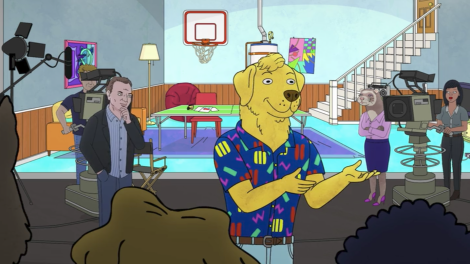
Anyways, we open on episode one in the early 90’s on the set of what will eventually become a more popular knock-off of the show Bojack is best known for. This helps the viewer get introduced to the upbringing of Bojack’s biggest frienemy, Mr. Peanutbutter, a happy-go-lucky golden retriever who accidentally stumbles onto the set and was basically handed the lead role in the show after “real actor” Vincent D’Onofrio begrudgingly explains to the producer,

“You don’t want an actor, you want a blank canvas upon which to project your own mawkish notions of goodness.”

I think this quote speaks directly to how sitcom television often does not try to convey real life, but rather easily digestible scenarios that the masses can find some way to vaguely connect to. Mr. Peanutbutter explains to the producer trying to hire him,

“Me, a star? But I have no experience, no formal training.”

to which the producer replies,

“Hey, you, you don’t need any of those things. You got ‘It.'”

I decided that I would start off this blog post with a very in-depth analysis of the intro since it does a lot to establish that often-discussed notion of “star quality” rather than actual talent when it comes to people of fame and show business, and in certain cases, politics.

After the opening title sequence, we flash forward to present day and learn that Mr. Peanutbutter is now running for governor of California solely on the basis of this aforementioned “star quality” (sound familiar?). He knows nothing about politics, nothing about the system, and is completely oblivious to what he is actually doing. His campaign is being run, much to behest of his wife Diane, by his ex-wife Katrina, a no-nonsense cut-throat adviser specifically hired by lobbyists simply to get someone elected who will represent them and their interests.

Meanwhile, the people in Bojack’s life continue going about their business, almost as if he never left. The closest person he has to a best friend, Todd, is conducting business with his friend Emily who has a romantic interest in him. However, Todd is struggling to figure out how he feels about romance and sexuality in general and is starting to believe that he might be asexual.

Diane, Mr. Peanutbutter’s wife is the only one who is trying to figure out what happened to Bojack and where he might be by calling and leaving voicemails every now and then, checking in to make sure he’s okay. As time runs out for Mr. PB to get the signatures he needs to have a chance at beating the incumbent governor, Mr. PB oddly decides to challenge him to a downhill ski race, something that literally makes its way through the house and senate as a legitimate way to win the seat of governor. This strange power move by Mr. PB is a clear example of how candidates in real life try to blur what politics are supposed to be about by deflecting facts and simply trying to get the people on the side of one of the candidates, even if the candidate is completely incompetent. They garner the support of the people by riling them up over a certain issue rather than explaining to them what their plan is to better the economy and society as a whole (which is what the current governor in the show is trying to do). Ironically, Mr. PB doesn’t even know how to ski. One of my favorite lines from him during this whole charade that I think perfectly exemplifies how ridiculous this all is:

“Well, I’m off to ski school, so I can learn how to ski, so I can become the governor. But, as the old saying goes, that’s politics.”

This sideshow continues until the incumbent governor actually has to race him, ending with Todd actually becoming governor because he crossed the finish line first (a formality not discussed in the legislation that led to this race).

This event also touches upon how certain media contributes to the skewing of facts and distracts the public with asinine news stories. As said by the main news anchor in this show when “supposedly” talking about the issues at hand,

“For the sake of “fairness” we’ve brought in two experts with opposite opinions who will now have equal time to say just those opinions because that’s what news is.”

After Mr. PB loses the ski race for governor and Todd is sworn in, he immediately resigns. Thus causing a special election to take place in which Mr. PB would actually have a good chance of winning. Mr. PB suddenly takes to the stage set up at the finish line and starts riling the crowd up again criticizing that the current governor was “sure to beat him” because he skied at Dartmouth, then prompting him to ask the crowd, “So where is the candidate for regular schmoes, like me?” (again, sound familiar?).

The episode ends with Diane in a panic, calling Bojack once more, only to find that his voicemail is full.

To conclude my first analysis of an episode, I would say that the reason I chose this show is because it touches on real world problems, plain and simple. Sure, the scenarios are ridiculous and outlandish, but the themes remain the same. The flightiness of “stars” who are given so much when they really didn’t do much to deserve it, coming to terms with one’s sexuality, political corruption and interference with lobbyists, and finally, scare tactics and deflections used to distract voters. All of these issues were touched upon to a certain degree in one 20-minute episode. This show cleverly and hilariously works in these problems from today’s society into something that causes an audience member to not only laugh, but think about how these problems in the show might just reflect the world in which we are living.

Introduction 1/25

bojack_horseman_by_shrimpy99-dbmx952

Hello,

My name is Cameron Brand and I am from Plymouth, NH and I am enrolled in Analyzing Television with Prof. David Stewart. I am a Theatre Arts Major with a focus in Technical Direction. I am excited to take another class related to media and both current and past popular culture.

I have loved television since the first time I could even comprehend what it actually was. Television has always been a very large part of my life. It will forever be a favorite relaxation pastime. I love the feeling of completely immersing oneself in the world of the show, and feeling like these characters are a part of your life, however corny that may sound.

The television show that I will be analyzing is not really a show on television, but rather a Netflix Original Series, Season 4 of Bojack Horseman. Bojack Horseman is an animated dark comedy show about the life and struggles of a half-human, half-horse former sitcom star in modern day Hollywood (although this “Hollywood”, and world in general is made up of humans and a myriad of anthropomorphic animals). This show (especially in Season 4), although animated and comedic, touches on some of the most serious issues today like depression, drug addiction, abusive relationships, and the toxic environment of the Hollywood business. I feel as though this connection of lighthearted animation and serious issues helps break down the barrier we often face when these types of issues need to be discussed. On top of all of this, it is one of the most incredible television shows, both artistically and conceptually that I have ever had the pleasure of viewing and I am very excited to delve deep into the inner meanings of this show through this blog.